
A riddle on product development projects to think about! Part 2
06 January 2016, Jelena Fedurko
I got a clarification for the riddle as presented in Part 1:
“Just one big BUT!! There is a resource conflict. The process engineers in the factories are responsible for both types of projects. New products require new/modified processes. Existing products require improvements – speed, quality, capacity, cost … and also require process engineers. YES, there are product development resources and they are a different set. The conflict arises when the new product is qualified for sale and must be industrialized in the factory. It is in the factory where the conflict occurs.
It is a ‘conflict’ between the factory and product development because the factory delays product industrialization for their factory reasons (local optimization). The product development people often face a question ‘Why should we speed up only to have to wait for the factory to do their part. It feels like the army … hurry up, and wait?’ “
This comment brings in new understanding of the conflict which is now truly between the product development projects and improvement projects.
Let’s look again at the first part of the clarification to the conflict:
“The process engineers in the factories are responsible for both types of projects. New products require new/modified processes. Existing products require improvements – speed, quality, capacity, cost … and also require process engineers. […] The conflict arises when the new product is qualified for sale and must be industrialized in the factory. It is in the factory where the conflict occurs.”
If we go along with the claim that there is a resource conflict, and based on the statements “The process engineers in the factories are responsible for both types of projects” and “It is in the factory where the conflict occurs”, the conflict seems to be of factory process engineers and looks like that:
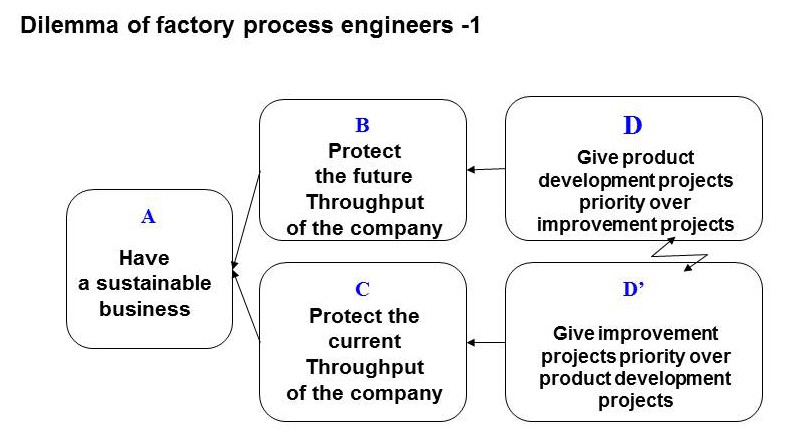
However, such conflict raises immediate questions:
- Do process engineers really face this dilemma?
- Are B and C the needs of process engineers in the factory?
- Is A the objective of process engineers in the factory?
If we still go along with the claim that there is a resource conflict regarding factory process engineers (they are responsible for both types of the project in the factory), and considering the statement “the factory delays product industrialization for their factory reasons (local optimization)”, then the conflict would look like the following dilemma of factory process engineers:
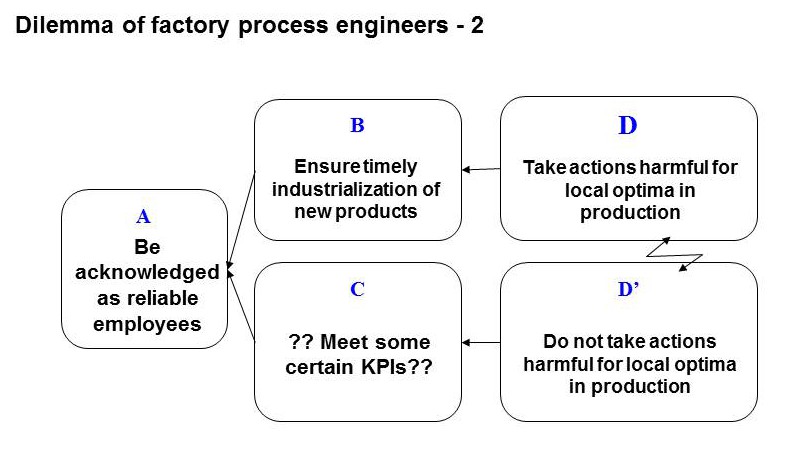
The need in C is not clear from the information in the riddle.
Do the factory process engineers really face this dilemma?
Absolutely NOT, as it is clearly stated by the continuation of the clarification: “It is a ‘conflict’ between the factory and product development because the factory delays product industrialization for their factory reasons (local optimization). The product development people often face a question ‘Why should we speed up only to have to wait for the factory to do their part. It feels like the army … hurry up, and wait?’ “
The factory DELAYS product industrialization projects – it means they have NO CLOUD and NO DILEMMA. The process engineers do NOT swing between: “Should we delay or not?” They delay – to protect the factory local optima. In terms of the Cloud above they pursue the lower leg of the Cloud.
Interestingly enough that the statement “The product development people often face a question ‘Why should we speed up only to have to wait for the factory to do their part. It feels like the army … hurry up, and wait?’ “ reveals that actually the riddle is speaking about the internal conflict/dilemma of the product development engineers (NOT of the factory process engineers!). And this dilemma looks like this:
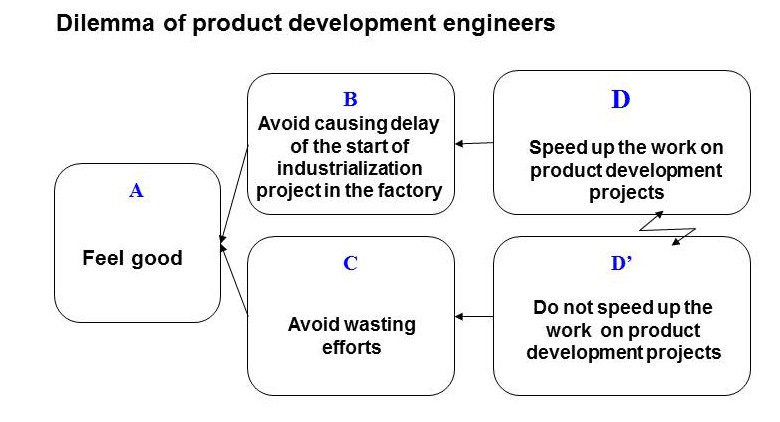
The internal dilemma of the product development engineers is caused by the Two-Sided Organizational Conflict Cloud, where one side is represented by the product development engineers and the other side – by factory process engineers:
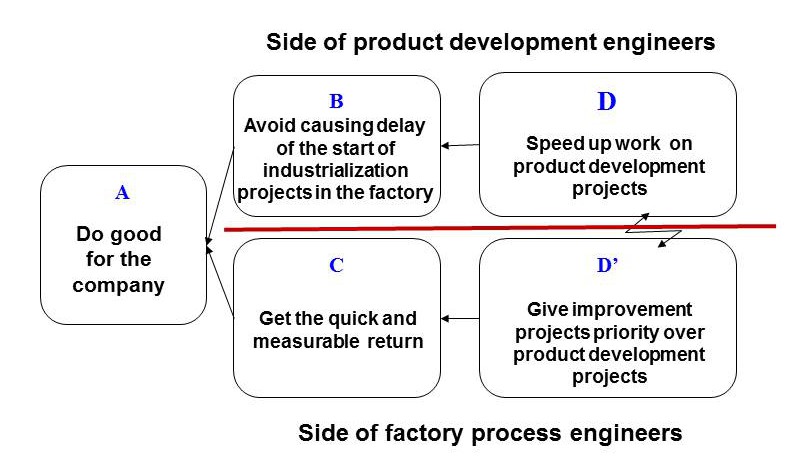
An observation: while in this two-sided conflict the process engineers side is presented by their preferred action from the dilemma ‘give improvement projects priority’ vs. ‘give product development projects priority’ (again, if such a dilemma exists at all), the side of product development engineers is presented by their forced action from their dilemma – as it is clear from the description that they prefer NOT to speed up the work on the projects as they see no sense and no appreciation of their effort further in the process (in the industrialization stage).
Another note regarding this two-sided conflict: the link “D endangers C” is not readily apparent. However, it is possible to argue that getting the new product timely ready to move to the industrialization stage will eventually force the factory process engineers to push further in time some of the preferred and ready to launch improvement projects, thus endangering their need for “quick and measurable return”.
The bottom line: it looks like even though the company believes that they [quoting the riddle:] “decide correctly which product development projects should be pursued, AND improvement projects are also selected correctly with proper application of T, I, OE and proper focus on the organization’s constraint”, the company currently has not moved beyond Step 2 of 5 Focusing Steps: Decide how to exploit the system constraint.
They do not demonstrate the difficulty in deciding. The difficulty is either in understanding the technical side of how to perform subordination – Step 3, or in following the plan for subordination actions.
The situation described in the riddle strongly suggests that there is no synchronization between the two departments/two sets of resources – factory process engineering and product development – and no alignment of the both departments to the same set of measurements that would encompass both types of projects.
Published by Jelena Fedurko, 06 January 2016