
The Five Focusing Steps, the Green Curve and the Red Curve. Part 1
03 January 2016, Oded Cohen
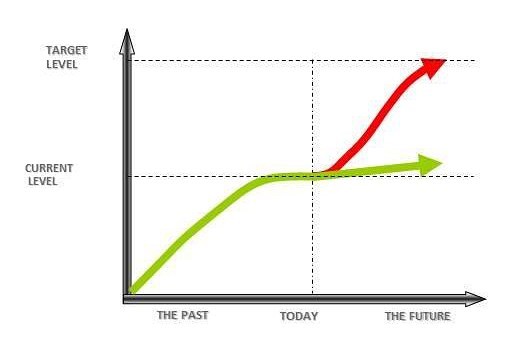
This graph with the green and red curve belongs to the core of TOC. It is embedded in the logo of TOCPA. It represents the motto of Ever Improve way of managing systems, it shows the point in which managing the constraint is critical for the future of the system, and more messages.
Recently, we have had discussions with some TOC practitioners that expressed some frustration about the progress of their implementations. They claimed that while the first part of the TOC project produced outstanding results within a few months, the continuation of the growth was not as rapid and not as easy as they have expected it to be.
Actually, they have not realized that they have just experienced being on the Green Curve, and hence were not aware of the reasons leading to this situation, nor to what is needed to be done and what is the way ahead.
I think that not enough attention has been paid to the graph and the way the graph is linked to the five focusing steps.
The first appearance of the green-red graph was in 1983. In was drawn by Eli Goldratt when we were discussing the continuous improvement of the performance of the companies that implemented OPT. There were many implementations in which the rate of improvement slowed down and even stagnated after having remarkable start. The graph of their performance was marked with a green marker – it has been referred thereafter as the “green curve”. There were few other implementations that continuously improved the performance of their systems. The graph presenting the desired POOGI was marked with the red marker. Both curves referred to our experience with world-wide implementations of DBR.
Even though OPT was the software to manage constraints in the flow – the formalization of the five focusing steps came only in 1986. The five steps helped to understand the underlying reasons for the green curve behavior.
Every logistical solution of TOC starts with implementing the first three steps of the five focusing steps: Identify, Decide how to Exploit, and Subordinate. These steps together are called: “getting your house in order”. As such, the first part of the TOC solution is “stop doing the wrong things”. This on itself brings significant benefits to the system. The system at the outset is ineffective and the first three steps squeeze the maximum of the system. Usually, the lack of effectiveness causes losing throughput and unnecessary operating expenses. Therefore, the first three steps bring reduction in OE and in Investment (by reducing stocks), and in many cases increase in Throughput.
The TOC Way of managing systems is focusing on managing the flow. The flow is governed by the constraint. Identifying and singling out the constraint bring immediate results. For the logistical solutions of TOC: MTO, MTA, DTA and CCPM there are ready made, proven procedures how to carry out the first three steps. Hence, significant results have been achieved within a few months of the implementation. The service industry has been using the TOC logistical solutions by adapting the procedures to their specific environment. In all cases, the first three steps build a robust managerial system that provides the base for the growth of the system.
Moving to the fourth step of focusing is more challenging.
Step four states: Elevate the system’s constraint(s)
Usually, we can state that while the system is under the first three steps, management is using every opportunity to achieve more throughput they can get their hands on. This is a natural part of step2 – “decide how to exploit”. Step four is needed when the system is unable to generate more throughput. The system needs more orders from the market, and this is not always simple.
Step four has no standard TOC solutions. The solution is developed specially for every system using Thinking Processes (TP) with the view of generating market offers that bring value.
Step four demands the active participation of several functions within the organization – marketing, sales, production and logistics – to develop the solutions, to experiment with them and continuously come with innovative ideas. This is challenging conceptually, operationally and organizationally. It demands rigorous thinking, persistence and patience.
Published by Oded Cohen, 03 January 2016